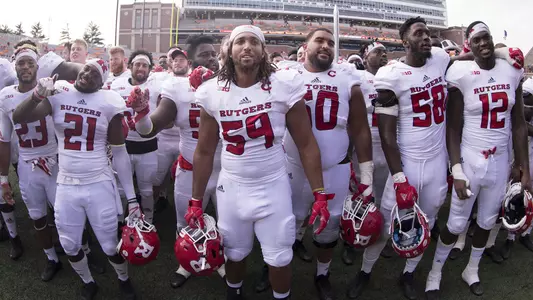
Brotherhood of Trust
Nov 21 | Football
Our Culture.
Those words run along the top of a board that hangs on a wall in the Rutgers football team room inside the Hale Center. Below it reads the following: Relentless Strain, Competitive Excellence and Brotherhood of Trust.
All three share equal importance in what they mean to the program, but it is the third hallmark that has been identified by head coach Chris Ash on several occasions as being much improved this season.
Following the Scarlet Knights' first Big Ten victory during his tenure, Ash pointed to the brotherhood of the football team as being a key factor in Rutgers being able to have other players step up in the absence of injured teammates.
"Yeah, really what it does is speaks volumes of the character of the players, and the selflessness of the players," said Ash. "We talked about this victory against Illinois, it wasn't just about the victory. We didn't out-execute Illinois. I thought we out-toughed them, in my opinion, and honestly it was more about the brotherhood of our football team that won that game.
"We had guys that were selfless, guys that did step up, guys that were hurting and we didn't know if they could play when the foot hit the ball on Saturday and they did play, and they played every rep, guys that were going down and running a lot, taking a lot of reps on special teams and on offense and defense that just didn't want to come out of the game, even though they were tired and hurting and they felt like they might start to cramp. That speaks a lot about our brotherhood and this team and in the locker room as much as it does anything else."
The word brotherhood resonates with the Scarlet Knights. It's a guiding force in how they conduct themselves with their teammates and coaches, and it speaks to strong camaraderie that most athletes on team sports strive for.
At his introductory press conference on Dec. 7, 2015, Ash spoke specifically to culture and building the right one in his program.
"The culture here at Rutgers will give us a chance for success," said Ash. "The culture will beat strategy every single time. We have to get the right culture here within our locker room and within our meeting room and on the field with these players.
But it's going to take great people and it's going to take the right culture and it's going to take alignment by everybody involved, and if we do that, we'll have a chance for success."
In many ways, the idea of brotherhood has come full circle beginning with Ash's introductory press conference to it being present on gameday in 2017. The buy-in from the players has been strong and they credit the impact of brotherhood on the team's improved performance this season.
"You can tell that our brotherhood has developed in a positive way, just by our play this season," said senior defensive lineman Sebastian Joseph. "Brotherhood is a very important thing because that shared suffering you have with someone really brings you closer to them.
"It gets you to know someone in hard times, especially during offseason training when things are tough. They see you at your worst moments and they're able to pick you up. That's what forms that brotherhood. This offseason was great and you can see that great positive change in the program. The culture right now is great and it's going to continue to grow and get better."
The man leading those offseason workouts, the one who pushes each player to get the most out of their given talent is head strength and conditioning coach Kenny Parker. From his time as a player at the University of Florida under Urban Meyer to a member of his strength staff at Ohio State, Parker has been around successful programs and knows the value of having a strong kinship within the locker room.
As someone who has played with and coached some of the best individual talents in college football history, Parker knows that success does not begin or end with one person. It requires full commitment from everyone wearing the uniform of that program to put together a success team.
"Brotherhood is by far, everything. I have not seen one man win a game on his own," said Parker. "There are too many variables, too many positions and everyone has to do their job. From all the conference championships, national championships and conference wins I have been around, those only happen when that guys no longer think about themselves and put all their trust into their teammates. At that point, they're not his teammate anymore and it becomes his brother. There has to be a mutual respect that when I step on that field and you do too, I got your back and you have mine"
Junior defensive back Saquan Hampton shares that sentiment.
"I think it's important to have because no one can accomplish a team goal by themselves," said Hampton. "Everyone has to work together in order to accomplish the goals."
In 2017, the Scarlet Knights have shown marked in improvements in several statistically categories from total defense, scoring defense, rushing defense, kickoff return defense and turnover margin. Rutgers has also matched its Big Ten win total through seven conference games. Since 1960, 30 teams have gone winless in conference play and only six have responded the following season with three or more wins in the Big Ten. Rutgers became the seventh team to join that group.
Every program in the country has a list of ideals and goals it seeks to achieve at the beginning of each season. When the roster includes over 100 players, countless assistant coaches and support staff members, it's integral that each person involved understands their role in the group ultimately achieving success.
"It's important to have guys playing for each other and not just for themselves," said junior tight end Jerome Washington. "When they come together, it's a stronger team and you can get through anything."
For senior offensive lineman Dorian Miller, the level of motivation that each player has grows stronger when they're playing for their teammates. The effect of knowing that your teammate is relying on you to do your job at a high level in order to be successful, it brings out the best in each player.
"It makes the motivation stronger when you have a group of guys that are willing to put all out on the line for one another," said Miller.
When Ash arrived nearly two years ago, he emphasized building the right culture within the program. Fast-forward to 2017 and it's clear that the message is being received among his players, coaches and support staff.
"When I think of brotherhood, I think of a group of guys coming together and playing for each other and also keeping each other accountable," said Washington. "If someone's not doing what they're supposed to do, you have the courage to speak up and know that if you're keeping them accountable, you're not attacking them as a person but making sure they are keeping up the culture you're trying to build."
Those words run along the top of a board that hangs on a wall in the Rutgers football team room inside the Hale Center. Below it reads the following: Relentless Strain, Competitive Excellence and Brotherhood of Trust.
All three share equal importance in what they mean to the program, but it is the third hallmark that has been identified by head coach Chris Ash on several occasions as being much improved this season.
Following the Scarlet Knights' first Big Ten victory during his tenure, Ash pointed to the brotherhood of the football team as being a key factor in Rutgers being able to have other players step up in the absence of injured teammates.
"Yeah, really what it does is speaks volumes of the character of the players, and the selflessness of the players," said Ash. "We talked about this victory against Illinois, it wasn't just about the victory. We didn't out-execute Illinois. I thought we out-toughed them, in my opinion, and honestly it was more about the brotherhood of our football team that won that game.
"We had guys that were selfless, guys that did step up, guys that were hurting and we didn't know if they could play when the foot hit the ball on Saturday and they did play, and they played every rep, guys that were going down and running a lot, taking a lot of reps on special teams and on offense and defense that just didn't want to come out of the game, even though they were tired and hurting and they felt like they might start to cramp. That speaks a lot about our brotherhood and this team and in the locker room as much as it does anything else."
The word brotherhood resonates with the Scarlet Knights. It's a guiding force in how they conduct themselves with their teammates and coaches, and it speaks to strong camaraderie that most athletes on team sports strive for.
At his introductory press conference on Dec. 7, 2015, Ash spoke specifically to culture and building the right one in his program.
"The culture here at Rutgers will give us a chance for success," said Ash. "The culture will beat strategy every single time. We have to get the right culture here within our locker room and within our meeting room and on the field with these players.
But it's going to take great people and it's going to take the right culture and it's going to take alignment by everybody involved, and if we do that, we'll have a chance for success."
In many ways, the idea of brotherhood has come full circle beginning with Ash's introductory press conference to it being present on gameday in 2017. The buy-in from the players has been strong and they credit the impact of brotherhood on the team's improved performance this season.
"You can tell that our brotherhood has developed in a positive way, just by our play this season," said senior defensive lineman Sebastian Joseph. "Brotherhood is a very important thing because that shared suffering you have with someone really brings you closer to them.
"It gets you to know someone in hard times, especially during offseason training when things are tough. They see you at your worst moments and they're able to pick you up. That's what forms that brotherhood. This offseason was great and you can see that great positive change in the program. The culture right now is great and it's going to continue to grow and get better."
The man leading those offseason workouts, the one who pushes each player to get the most out of their given talent is head strength and conditioning coach Kenny Parker. From his time as a player at the University of Florida under Urban Meyer to a member of his strength staff at Ohio State, Parker has been around successful programs and knows the value of having a strong kinship within the locker room.
As someone who has played with and coached some of the best individual talents in college football history, Parker knows that success does not begin or end with one person. It requires full commitment from everyone wearing the uniform of that program to put together a success team.
"Brotherhood is by far, everything. I have not seen one man win a game on his own," said Parker. "There are too many variables, too many positions and everyone has to do their job. From all the conference championships, national championships and conference wins I have been around, those only happen when that guys no longer think about themselves and put all their trust into their teammates. At that point, they're not his teammate anymore and it becomes his brother. There has to be a mutual respect that when I step on that field and you do too, I got your back and you have mine"
Junior defensive back Saquan Hampton shares that sentiment.
"I think it's important to have because no one can accomplish a team goal by themselves," said Hampton. "Everyone has to work together in order to accomplish the goals."
In 2017, the Scarlet Knights have shown marked in improvements in several statistically categories from total defense, scoring defense, rushing defense, kickoff return defense and turnover margin. Rutgers has also matched its Big Ten win total through seven conference games. Since 1960, 30 teams have gone winless in conference play and only six have responded the following season with three or more wins in the Big Ten. Rutgers became the seventh team to join that group.
Every program in the country has a list of ideals and goals it seeks to achieve at the beginning of each season. When the roster includes over 100 players, countless assistant coaches and support staff members, it's integral that each person involved understands their role in the group ultimately achieving success.
"It's important to have guys playing for each other and not just for themselves," said junior tight end Jerome Washington. "When they come together, it's a stronger team and you can get through anything."
For senior offensive lineman Dorian Miller, the level of motivation that each player has grows stronger when they're playing for their teammates. The effect of knowing that your teammate is relying on you to do your job at a high level in order to be successful, it brings out the best in each player.
"It makes the motivation stronger when you have a group of guys that are willing to put all out on the line for one another," said Miller.
When Ash arrived nearly two years ago, he emphasized building the right culture within the program. Fast-forward to 2017 and it's clear that the message is being received among his players, coaches and support staff.
"When I think of brotherhood, I think of a group of guys coming together and playing for each other and also keeping each other accountable," said Washington. "If someone's not doing what they're supposed to do, you have the courage to speak up and know that if you're keeping them accountable, you're not attacking them as a person but making sure they are keeping up the culture you're trying to build."

Players Mentioned

DB
/ Football
DL
/ Football
OL
/ Football
TE
/ FootballTuesday, September 15
Tuesday, September 08
Tuesday, September 08
Friday, September 04