Sean Campbell: Upon Further Review
Jan 03 | Baseball
Former Rutgers baseball pitcher works in MLB Replay Operations Center
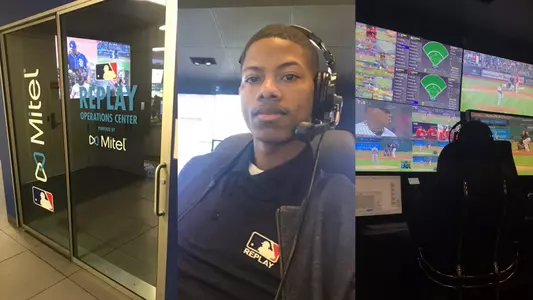
On a typical day during the Major League Baseball season there could be 15 games in action between the 30 clubs. Behind the scenes in Chelsea, New York, the MLB Replay Operations Center is monitoring each game intently for the potential for a review of a close play. Ultimately, the umpires in the room have final say on plays that could decide win and losses, and it is important for them to have all the support necessary to make such decisions.
Sean Campbell was a member of the Rutgers baseball team from 2008 to 2011 as a left-handed pitcher and graduated as an information technology and informatics major. From Trenton, New Jersey, he now works as a sales engineer for a cyber-security company in New York, but also served as a technician in the MLB Replay Center for the 2018 season. Once MLB adopted replay, Campbell knew his skillset would be perfect as a technician. After being unable to find a job posting at first, he ran into some good luck on a train home one day from New York that set him on the right path.
"I was on my way back from New York, and on the train that I got on I happened to see someone wearing an MLB Replay pullover," Campbell said. "So I just sat down next to him and we had a nice conversation, and one thing led to another and he introduced me to his manager. I got to sit down with his manager and we talked about the position. We talked about the Replay Operation Center, and I was quite clear about my interest in the role and also if it was the time commitment I was under the impression it had. He was able to clarify for me that they were looking for help."
Campbell was able to join the team and started training right away.
"Going to the Replay Operations Center in Chelsea was definitely eye-opening, just given the fact that this literally has tentacles into every game," Campbell said. "Just imagine being in a command center while every MLB game that's scheduled for that night is playing. You get to interact with the different umpires around the league. So umpires that are umpiring at an actual game, then they'll come through replay for a week as replay assignment. Just as soon as I am interacting with an umpire, I can see him on TV another night umping first base in Yankee Stadium or umpiring home plate out in Anaheim. I thought that was really cool."
There are six stations monitoring games throughout the country as they take place and one umpire is setup at each, looking at two or three games. As part of his job, Campbell makes sure each station has the proper feeds and angles needed for the umpire to watch and make judgments.
"As an operator, it's looking out for close plays," Campbell explained. "There could be one close play in one game that needs to be escalated into challenge mode, meaning that at the actual stadium they're going into replay review. If they go into replay review at the stadium, then that operator needs to be focused on just that game. But then what happens is, he still has another game in his station that needs to continue being monitored as well. I then help get those games into other stations to ensure that if there were a challenge or replay review in one of those games, it's properly managed."
When a challenge does take place, the umpires on site will put a headset on and be in communication with the umpire in the replay room. The replay center would have already been alerted to the possibility of a challenge and already started looking. Sometimes it can be tough to tell in real time, but that is the purpose of replay. Everyone wants the correct call in the end.
"In real time, you can't really tell because it's such a bang-bang play," Campbell said. "But because of slo-mo, you're able to actually see it frame by frame and to use the software in the replay operation center to then go ahead and confirm if the call was the correct call."
Campbell also works a replay technician for the Big Ten, operating the software for football, basketball and wrestling. It is a way to stay involved with sports.
"Honestly, it was just something that Steve Comeau (Associate Director IT at Rutgers), who I owe my replay career to, he introduced me to it," Campbell said. "I was interning with him one semester while I was playing baseball, and after shadowing him around and meeting his staff and being involved in some different projects, he asked me if I wanted to get involved with replay, if I wanted to learn how to do replay. And I shadowed, at the time, Joe Vassilatos (Unit Computing Manager) who also works in IT at Rutgers still. He was the replay operator and he worked in tandem with the software company that outfits replay for all the major football conferences. They used to have someone that comes on site, I would shadow them and then after that I was kind of grooved into doing it on my own and I've never stopped."
Sean Campbell was a member of the Rutgers baseball team from 2008 to 2011 as a left-handed pitcher and graduated as an information technology and informatics major. From Trenton, New Jersey, he now works as a sales engineer for a cyber-security company in New York, but also served as a technician in the MLB Replay Center for the 2018 season. Once MLB adopted replay, Campbell knew his skillset would be perfect as a technician. After being unable to find a job posting at first, he ran into some good luck on a train home one day from New York that set him on the right path.
"I was on my way back from New York, and on the train that I got on I happened to see someone wearing an MLB Replay pullover," Campbell said. "So I just sat down next to him and we had a nice conversation, and one thing led to another and he introduced me to his manager. I got to sit down with his manager and we talked about the position. We talked about the Replay Operation Center, and I was quite clear about my interest in the role and also if it was the time commitment I was under the impression it had. He was able to clarify for me that they were looking for help."
Campbell was able to join the team and started training right away.
"Going to the Replay Operations Center in Chelsea was definitely eye-opening, just given the fact that this literally has tentacles into every game," Campbell said. "Just imagine being in a command center while every MLB game that's scheduled for that night is playing. You get to interact with the different umpires around the league. So umpires that are umpiring at an actual game, then they'll come through replay for a week as replay assignment. Just as soon as I am interacting with an umpire, I can see him on TV another night umping first base in Yankee Stadium or umpiring home plate out in Anaheim. I thought that was really cool."
There are six stations monitoring games throughout the country as they take place and one umpire is setup at each, looking at two or three games. As part of his job, Campbell makes sure each station has the proper feeds and angles needed for the umpire to watch and make judgments.
"As an operator, it's looking out for close plays," Campbell explained. "There could be one close play in one game that needs to be escalated into challenge mode, meaning that at the actual stadium they're going into replay review. If they go into replay review at the stadium, then that operator needs to be focused on just that game. But then what happens is, he still has another game in his station that needs to continue being monitored as well. I then help get those games into other stations to ensure that if there were a challenge or replay review in one of those games, it's properly managed."
When a challenge does take place, the umpires on site will put a headset on and be in communication with the umpire in the replay room. The replay center would have already been alerted to the possibility of a challenge and already started looking. Sometimes it can be tough to tell in real time, but that is the purpose of replay. Everyone wants the correct call in the end.
"In real time, you can't really tell because it's such a bang-bang play," Campbell said. "But because of slo-mo, you're able to actually see it frame by frame and to use the software in the replay operation center to then go ahead and confirm if the call was the correct call."
Campbell also works a replay technician for the Big Ten, operating the software for football, basketball and wrestling. It is a way to stay involved with sports.
"Honestly, it was just something that Steve Comeau (Associate Director IT at Rutgers), who I owe my replay career to, he introduced me to it," Campbell said. "I was interning with him one semester while I was playing baseball, and after shadowing him around and meeting his staff and being involved in some different projects, he asked me if I wanted to get involved with replay, if I wanted to learn how to do replay. And I shadowed, at the time, Joe Vassilatos (Unit Computing Manager) who also works in IT at Rutgers still. He was the replay operator and he worked in tandem with the software company that outfits replay for all the major football conferences. They used to have someone that comes on site, I would shadow them and then after that I was kind of grooved into doing it on my own and I've never stopped."

Rutgers Baseball vs. Michigan Highlights | 3/27/2026
Saturday, March 28
Rutgers Baseball vs. Delaware Highlights | 3/24/2026
Tuesday, March 24
Rutgers Baseball at Illinois Highlights | 3/22/2026
Sunday, March 22
Rutgers Baseball vs. Monmouth Highlights | 3/17/2026
Tuesday, March 17